
Bulk Google Index Checker from $0.0007 / 1 check
Verify 100,000 URLs Instantly. For SEOs who need to check backlink indexation, audit a site migration, or find out why GSC says "crawled - currently not indexed" across thousands of pages.
What is Google Index Checking?
At its core, index checking is the process of verifying if Google has added a specific URL to its database to be served in search results. It sounds technical, but the business implication is simple: an unindexed page generates zero traffic and passes zero link equity. It is effectively invisible.
Why can't you just use Google Search Console?
For your own website, GSC is fine—if you don't mind the data lag of 3-4 days. But professional SEO rarely stops at your own domain. You need to verify:
- Backlinks: You cannot check guest posts or tier-2 links in GSC because you don't own those sites.
- Massive Scales: Manually checking
site:urlfor 10,000 pages is physically impossible. - Real-time Status: When you buy links, you need to know if they are live today, not next week when GSC updates.
This is where a bulk website index checker becomes mandatory. It bypasses the delays and ownership restrictions, querying Google directly to give you a definitive "Indexed" or "Not Indexed" status for thousands of URLs instantly — see the FAQ.
Google Search Console vs. SpeedyIndex
| Feature | Google Search Console | SpeedyIndex |
|---|---|---|
| Check Any Website (Backlinks) | ❌ No (Ownership required) | ✅ Yes (Any URL) |
| Daily Limit | ~2,000 (Property limit) | Unlimited |
| Data Freshness | Delayed (3-4 days lag) | Real-time (Live SERP) |
| Check Speed | Manual / Slow | 1,000 links / minute |
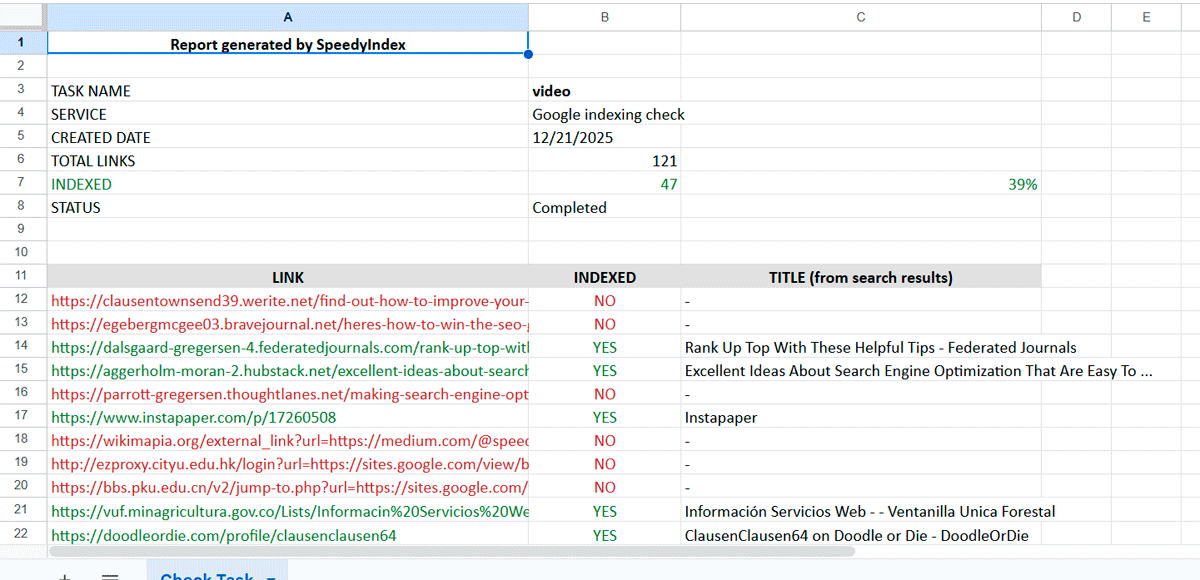
| Indexing reports | ❌ No | ✅ Detailed reports (.xlsx) |
| Automation | ❌ No | ✅ REST API |
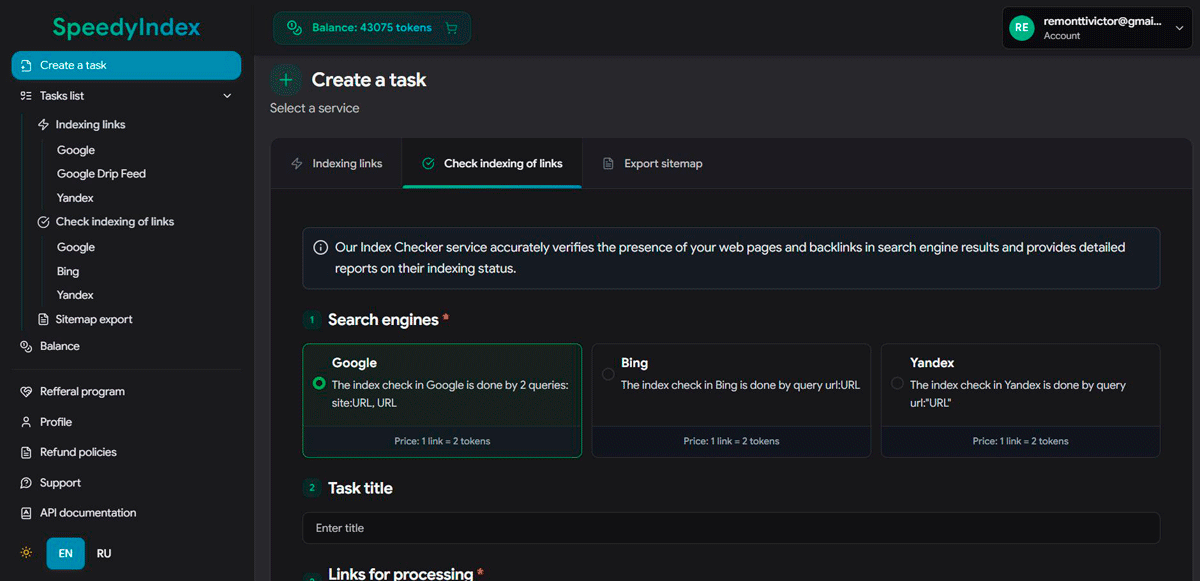
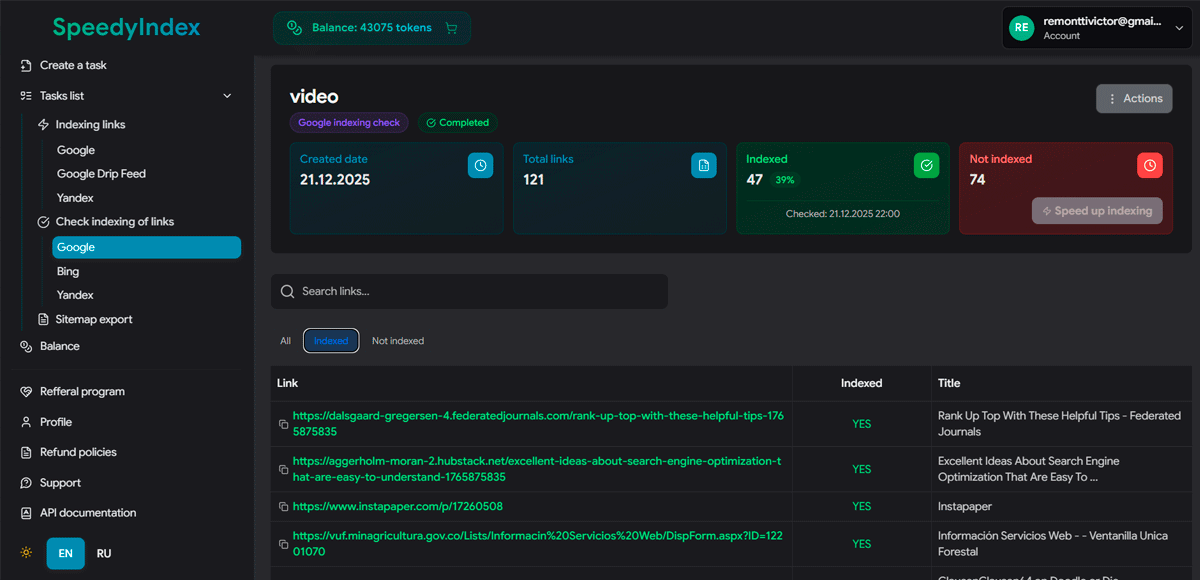

How to Bulk Check Google Index Status
No complex setups. No API keys. We built this for speed because your time is valuable. You give us a list, we give you actionable data.
Prepare Your List
Create a standard .txt file with one URL per line. The system handles up to 100,000 URLs in a single file. For quick checks, you can paste up to 20 links directly.
Submit via Web App or Bot
Drag-and-drop your file in our new web app or send it via the classic Telegram bot. Your job is done.
Get a Detailed Report
You’ll receive a clear report categorizing each URL as "Indexed" or "Not Indexed". For every indexed page, we also pull its live TITLE directly from Google's search results—the ultimate proof of visibility.
Our Method: We confirm status using multiple queries, including site:URL and "URL", for over 99% accuracy.
Automated Google Index Checker API for Enterprise Scale
Deploy mass indexing checks programmatically. Our high-throughput REST API v2 is engineered for SEO agencies requiring bulk URL validation with zero reporting lag.
1,000 Links/Min: High-speed mass processing.
Full Integration: Python, PHP, Node.js SDKs.
99.9% Uptime: Enterprise-grade reliability.
curl -X POST "https://api.speedyindex.com/v2/task/google/checker/create" \
     -H "Authorization: YOUR_API_KEY" \
     -d '{"urls": ["https://site.com/p1", "https://site.com/p2"]}'
Calculate Your Wasted Time & Effort
Estimate how many hours you lose to manual checks and see the value of automation.
Why Your Team Needs More Than Just Search Console
GSC is essential, but it was never designed for the speed and scale that professional SEO demands. Here's where it hits a wall—and where a dedicated tool takes over.
No Backlink Audits
You can't check URLs on sites you don't own. This makes GSC useless for verifying link building campaigns or analyzing a competitor's indexed assets.
Crippling Quotas
The URL Inspection tool is built for single checks, not scale. Try checking 1,000 pages and see what happens. (Spoiler: you'll give up after 50).
The Data Lag
GSC data isn't live; it's a snapshot from the past. For time-sensitive tasks, it's like using yesterday's weather report to plan today's mission.
No Competitor Analysis
Want to see which pages of a competitor's site are falling out of the index after an update? You can't. With our tool, you can.
See The Tool in Action
Watch this 90-second video to see how easily you can check thousands of URLs directly via SpeedyIndex Web App.
From Daily Audits to High-Stakes Migrations: Where Professionals Need Certainty
This isn't just a checker; it's a diagnostic tool for the most critical moments in SEO. Here’s how specialists get the data they need to act, not just analyze.
For Link Builders & SEO Agencies
Your link building ROI is zero until Google indexes the link. That expensive guest post? A "ghost link". Your entire PBN? A money pit. Our tool is the final, mandatory step in any campaign—verifying that every dollar you spend actually translates into authority that Google can see.
Guide to Verifying Link Equity →For E-commerce Stores
E-commerce SEO is a battle for crawl budget. Faceted navigation and parameter-heavy URLs can create millions of low-value pages, leaving critical product URLs undiscovered. Use our checker to audit your sitemaps against Google's live index to find and fix "orphan" product pages that aren't generating revenue.
Fixing E-commerce Visibility →For Post-Migration Audits
A site migration is the most dangerous moment in SEO. It's not just about 301 redirects; it's about ensuring Google de-indexes old URLs and accepts the new canonicals. Any delay means lost rankings. Our checker is your safety net: bulk-check old and new URL lists to confirm the "handover" is complete.
The Post-Migration Safety Checklist →For Technical SEO Diagnosis
GSC gives you the symptom, not the diagnosis. A "Crawled - not indexed" alert across 50,000 pages is a catastrophe, not a data point. Is it a specific page template? A shared content issue? Export the list from GSC, run it through our tool, and get the hard data you need to build a real recovery plan.
Diagnosing GSC Errors at Scale →Simple, Transparent Pricing
No subscriptions, no hidden fees. Every package is a one-time purchase, and your credits never expire. Check as many links as you need with unlimited daily limits, giving you total freedom. We offer flexible payment options, including PayPal, debit cards, and major cryptocurrencies.
- 50 INDEXED LINKS IN GOOGLE
- 1,666 INDEX CHECKS GOOGLE
- 2,500 INDEX CHECKS (Google/Bing/Yandex)
- 2,500 BACKLINK CHECKS
- 250 INDEXED LINKS IN YANDEX
- 300 INDEXED LINKS IN GOOGLE
- 10,000 INDEX CHECKS GOOGLE
- 15,000 INDEX CHECKS (Bing/Yandex)
- 15,000 BACKLINK CHECKS
- 1,500 INDEXED LINKS IN YANDEX
- 1,200 INDEXED LINKS IN GOOGLE
- 40,000 INDEX CHECKS GOOGLE
- 60,000 INDEX CHECKS (Bing/Yandex)
- 60,000 BACKLINK CHECKS
- 6,000 INDEXED LINKS IN YANDEX
- 2,500 INDEXED LINKS IN GOOGLE
- 83,333 INDEX CHECKS GOOGLE
- 125,333 INDEX CHECKS (Bing/Yandex)
- 125,000 BACKLINK CHECKS
- 12,500 INDEXED LINKS IN YANDEX
- 7,000 INDEXED LINKS IN GOOGLE
- 233,333 INDEX CHECKS GOOGLE
- 350,000 INDEX CHECKS (Bing/Yandex)
- 350,000 BACKLINK CHECKS
- 35,000 INDEXED LINKS IN YANDEX
- 15,000 INDEXED LINKS IN GOOGLE
- 500,000 INDEX CHECKS GOOGLE
- 750,000 INDEX CHECKS (Bing/Yandex)
- 750,000 BACKLINK CHECKS
- 75,000 INDEXED LINKS IN YANDEX
Trusted by SEO Professionals
Don't just take our word for it. Here is what agency owners and link builders say about our accuracy.



Find the Deadweight in Your SEO.
Every unindexed backlink is wasted money. Every unindexed product page is lost revenue. Stop guessing and get hard data.
Test Your "Problem" URLs for FreeGSC Problem Diagnostics: Quick Reference Guide
Encountering messages in Google Search Console (GSC)? This table is a compact—but as complete as possible—glossary of Indexing and Page indexing statuses: what they mean, what they usually indicate (technical SEO, crawl budget, canonicalization, duplication, quality), and what to fix first. Use SpeedyIndex to validate the live Google index status of affected URLs in bulk (Indexed / Not Indexed) and to monitor progress after changes.
| GSC Issue / Status | What it Means (Plain English) | Typical Root Cause (SEO / Tech) | Urgency | What to Do Next (Fix) |
|---|---|---|---|---|
| Crawled - currently not indexed | Googlebot fetched the page but decided not to keep it in the index (for now). | Thin/duplicate content, weak internal links, low perceived value, soft-duplicate templates, faceted pages, poor E‑E‑A‑T signals. | High | Improve quality + internal links → |
| Discovered - currently not indexed | Google knows the URL exists but hasn’t crawled it yet. | Crawl budget limits, low priority, huge URL volume, weak internal linking, slow server, low-quality discovery signals, sitemap noise. | Medium | Optimize crawl budget & discovery → |
| Duplicate, Google chose different canonical than user | Google indexed a different URL version, ignoring your declared canonical. | Conflicting canonicals, inconsistent internal linking, parameter URLs, pagination, mixed HTTP/HTTPS, WWW/non‑WWW, hreflang/canonical mismatch. | High | Fix canonicalization signals → |
| Alternate page with proper canonical tag | This URL is an alternate; Google indexes the canonical instead. | Expected duplicates (tracking parameters, print versions, filtered URLs) with correct canonical. | Varies | Confirm canonicals are intentional → |
| Duplicate without user-selected canonical | Google detected duplication and picked a canonical by itself. | Missing canonical tags, parameter duplication, similar product/category pages, near-duplicates. | Medium | Add canonicals & consolidate → |
| Soft 404 | Returns 200 OK, but looks like a “not found / empty / no results” page to Google. |
Empty categories, thin tag pages, internal search pages, “no products found”, placeholder content, blocked assets causing blank render. | High | Return proper status or improve content → |
| Page with redirect | The URL redirects to another URL (usually fine). | 301/308 consolidation, migration, trailing slash, HTTP→HTTPS; issues appear with chains/loops, wrong target, or temporary redirects. | Medium | Audit redirect chains & targets → |
| Redirect error | Google can’t follow the redirect correctly. | Redirect loops, too many hops, malformed Location header, mixed protocols, blocked by robots, redirecting to 4xx/5xx. | High | Fix loops/chains and final 200 → |
| Excluded by 'noindex' tag | A meta robots tag or HTTP header tells Google not to index the page. | Intentional noindex, staging environment rules, CMS/plugin misconfiguration, template-wide noindex, X‑Robots‑Tag on PDFs. | Varies | Audit noindex sources → |
| Blocked by robots.txt | Googlebot is not allowed to crawl the URL. | robots.txt disallow rules, overly broad patterns, blocked CSS/JS causing rendering issues, accidental environment blocks. | High | Fix robots.txt rules → |
| Blocked due to unauthorized request (401) | Googlebot can’t access the page (authentication required). | Login walls, restricted content, misconfigured auth, WAF rules, expired access tokens. | High | Allow Googlebot or noindex intentionally → |
| Blocked due to access forbidden (403) | Server refuses access to Googlebot. | Firewall/WAF (Cloudflare), geo/IP blocks, hotlink protection, anti-bot rules, misconfigured server ACL. | High | Whitelist Googlebot / adjust WAF → |
| Not Found (404) | The URL doesn’t exist. | Broken internal links, removed products, wrong canonical/redirect target, sitemap with dead URLs. | Medium | Fix links, redirect or keep 404/410 → |
| Blocked because of other 4xx issue | Other client error prevents crawling/indexing. | 429 Too Many Requests, 400/422 bad requests, edge/CDN misconfiguration, header size limits. | High | Stabilize responses and rate limits → |
| Page removed because of legal complaint | Google removed the page from results for legal reasons. | DMCA / court orders / policy removals. | High | Review legal removal details → |
| Server error (5xx) | Server failed while Google tried to fetch the page. | Overload, crashes, timeouts, PHP/DB failures, CDN origin errors; persistent 5xx may trigger deindexing. | High | Fix uptime, logs, capacity → |
| DNS error | Google can’t resolve the domain. | Nameserver downtime, misconfigured DNS records, propagation issues, expired domain. | High | Restore DNS stability → |
| Host load exceeded | Google reduces crawling because the host seems overloaded. | Slow TTFB, high error rate, insufficient resources, aggressive bot protection, rate limiting. | High | Improve performance & capacity → |
| Crawl anomaly | Google encountered an unexpected fetch problem. | Intermittent timeouts, flaky responses, varying status codes, unstable rendering, blocked resources. | Medium | Stabilize response & rendering → |
| Indexed, though blocked by robots.txt | Google indexed the URL without crawling it (limited info). | Blocked crawling but URL discovered via links; snippet may be poor; can cause indexing confusion. | High | Allow crawling or noindex → |
| Duplicate, submitted URL not selected as canonical | You submitted the URL (e.g., in sitemap) but Google chose another canonical. | Sitemap contains non-canonical URLs, internal links point to alternates, inconsistent trailing slash/case. | Medium | Submit only canonical URLs → |
| Blocked due to restricted hreflang | Language/region alternates are misconfigured (and indexing signals degrade). | Missing return tags, wrong language codes, canonical/hreflang conflicts, blocked alternates. | Medium | Audit hreflang + canonical pairing → |
| Submitted URL marked 'noindex' | The URL is in your sitemap, but it’s explicitly noindexed. | Misaligned SEO intent (sitemap vs directives), staging rules, template mistakes. | High | Remove from sitemap or remove noindex → |
| Submitted URL has crawl issue | GSC reports problems fetching a submitted URL. | Timeouts, redirect issues, blocked resources, intermittent server errors, WAF challenges. | High | Fix fetch path & stability → |
| Indexed (but not ranking / low impressions) | The page is in the index, but visibility is weak. | Search intent mismatch, weak content depth, poor internal linking, cannibalization, low authority, poor CTR/snippets. | Medium | Improve relevance, content & links → |
Tip: After implementing fixes, run a bulk re-check in SpeedyIndex to confirm which URLs are now Indexed,
and which remain Not Indexed—especially after migrations, redirect cleanups, canonical updates, and content refreshes.
Still struggling to get them indexed organically? Don't wait weeks for Googlebot to return. Use our
pay-per-result Google indexing service
to force Google to crawl and index your problem URLs within 7 days.
Frequently Asked Questions
Google indexation FAQ for SEO specialists: URL indexing check, Google Search Console (GSC), crawl budget, canonical/redirects, and bulk index monitoring with SpeedyIndex.
Index checking basics (Google)
How can I check if a URL is indexed by Google?
You can verify Google index status in three common ways: (1) Manual SERP check using site:example.com/page (or a URL-focused query), (2) Google Search Console → URL Inspection for a verified property, (3) Bulk index checking with SpeedyIndex to validate thousands of URLs (pages, backlinks, drop domains, competitors) in one task.
What does “Indexed by Google” actually mean?
“Indexed” means the URL is stored in Google’s index and can be returned in search results (SERP). A URL can be discovered or crawled without being indexed if Google considers it duplicate, low-value (thin content), canonicalized to another URL, blocked, or not worth indexing for quality/crawl budget reasons.
Can I check indexing for any website (not only mine)?
Yes. GSC only works for sites you own/verify. SpeedyIndex can check the live index status for any URL: backlinks on third-party sites, guest posts, PR pages, parasite pages, competitor URLs, and large URL lists for audits.
How fast Google indexes pages
How long does it take for Google to index a page?
Indexing speed ranges from hours to weeks. It depends on site authority, internal linking, crawl budget, server performance, sitemap freshness, and content uniqueness. You can speed it up with GSC URL Inspection (request indexing), proper XML sitemap submission, internal links from strong pages, and (where applicable) the Google Indexing API for supported content types. SpeedyIndex helps you track indexation progress across large batches. For a large batch of unindexed URLs, drip-feed indexing can distribute subsequent indexing requests across multiple days.
What is crawl budget and why does it matter for indexation?
Crawl budget is the practical limit of how many URLs Googlebot will crawl on your site within a given period. Massive faceted navigation, parameter URLs, redirect chains, and slow hosting can waste crawl budget and delay indexing. Bulk checks with SpeedyIndex help you identify which sections (categories, product pages, tags, filters) are actually indexed.
Google Search Console statuses (Indexing reports)
Why isn't my page indexed?
Common causes include technical blocks (noindex, robots.txt disallow, X‑Robots‑Tag), HTTP errors (404/410/5xx), canonical issues, duplicate content, soft 404, and quality signals. In GSC you may see statuses like Discovered – currently not indexed, Crawled – currently not indexed, or Duplicate, Google chose different canonical. SpeedyIndex complements GSC by giving a fast “in SERP / not in SERP” snapshot at scale.
What's the difference between “Crawled – currently not indexed” and “Discovered – currently not indexed”?
Discovered means Google knows the URL exists (from links/sitemaps), but hasn’t fetched it yet—often a crawl budget/priority issue. Crawled means Googlebot fetched the page but decided not to index it (often due to perceived low value, duplication, or canonicalization). Both can be addressed via content improvements, stronger internal links, and technical cleanup.
Is “Page with redirect” an error?
Usually it’s informational, not an error. It indicates the URL resolves via 301/302/307/308 to another destination. It becomes a problem when the redirect is unintended, forms long chains, creates loops, points to non-200 targets, or uses temporary redirects (302/307) where a permanent 301/308 is required for SEO consolidation.
How do canonical tags affect indexation?
Canonical signals tell Google which URL version is preferred. If the canonical points elsewhere (or Google chooses a different canonical), the inspected URL may stay crawled but not indexed. This is common with faceted filters, UTM parameters, pagination duplicates, and near-duplicate product variants.
Bulk checks, API & accuracy
Can I check Google index status using an API?
Yes. Google provides Search Console APIs for verified properties and the Indexing API for specific use cases/content types. For large-scale workflows (audits, backlink validation, integrations, monitoring), SpeedyIndex offers an API for bulk index checks across any URL list with automation-ready responses.
How accurate is bulk index checking compared to manual checks?
SpeedyIndex is designed to be as close as possible to a real SERP verification workflow and is suitable for scaling beyond manual checks. Accuracy can be affected by personalization, localization, temporary SERP fluctuations, and data center differences—so for mission-critical cases, we recommend re-checking and monitoring trends rather than relying on a single point-in-time result.
Can Google Search Console data be wrong or delayed?
GSC is the primary source for diagnostics, but it can have reporting delays, sampling, and lag between crawling/indexing events and UI updates. For time-sensitive operations (new page launch, backlink campaign validation), SpeedyIndex provides a fast external confirmation of live index presence.
Safety & compliance (checks, proxies, captchas)
Is checking index status safe? Will Google ban my IP?
Bulk SERP checks can trigger rate limits if you do them manually at scale. With SpeedyIndex, checks are performed via our infrastructure (distributed servers/proxies) so your personal IP doesn’t need to query Google directly. This helps reduce the risk of blocks/captchas during large verification runs.
What to do next (fixes & indexing actions)
What should I do with “Not Indexed” URLs?
Start with technical checks: response code 200, no noindex, allowed in robots.txt, correct canonical, no redirect chain, and a clean internal linking path. If the URL is technically valid, improve content uniqueness, add internal links from authoritative pages, update the XML sitemap, and request indexing in GSC where possible.
If you don't have GSC access (for example, for backlinks or guest posts), or if GSC is moving too slow, you can use our
automated link indexer
to speed up the process. For large batches, SpeedyIndex Checker helps you prioritize by quickly separating indexed vs non-indexed pages first.
Does SpeedyIndex help with backlinks and link building workflows?
Yes. You can validate whether backlink donor pages are indexed (and therefore more likely to pass value), monitor guest posts/PR placements, and catch deindexing events. This is useful for SEO agencies, affiliate teams, and anyone running ongoing link acquisition.
Can I check indexing for Yandex or Bing too?
Yes. SpeedyIndex supports index checking for multiple search engines (including Yandex), letting you run the same URL list across different indexes depending on your SEO strategy and target markets.